
People who make a difference, place an effort and make the difference PT 1
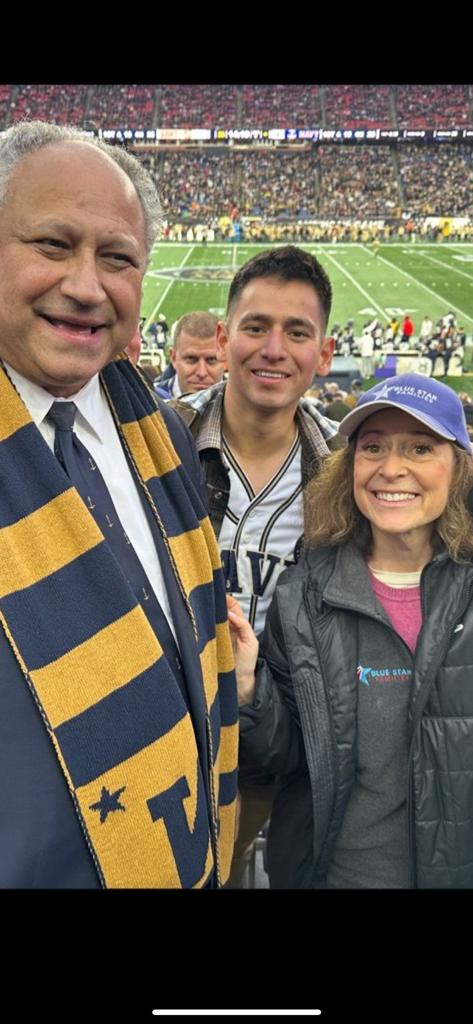
Love the people who are dedicated to helping others and making a difference in their lives, especially young adults. I wanted to share this picture of three people who put so much effort in changes and success. Here It was some time ago at the graduation of my nephew in the Naval Academy, I got to listen to such a beautiful encouraging speech from Lloyd J. Austin III is the 28th secretary of defense, a graduate of the U.S. Military Academy at West Point, N.Y., Austin served 41 years in uniform, retiring as a four-star Army general after three years as commander of U.S. Central Command. As well as, this gentleman Navy Secretary Carlos del Toro spoke, recently I found something that caught my attention…shared below from an interview from the US Naval Institute as well as the works of Kathy Roth-Douquet and what she does for the Military families and Veterans.
An excerpt of the US Naval Institute interview with Carlos del Toro
When I came in as Secretary, I put together an Education Task Force of high-powered individuals who have a lot of experience and education, both as civilians and military folks. I charged them with assessing all the studies that have been done in the past five years and instructed them to develop a clear, concise set of recommendations on investments to be made over the next Future Years Defense Plan. That group is concluding its efforts; I hope to have guidance for the direction we want to go and a set of concrete recommendations I can implement quickly to improve our education system across the department.2 That includes the Naval War College, the Naval Postgraduate School, the Marine Corps Command and Staff College, the Naval Academy, and our Navy Community College as well
Midn: Sir, also in your strategic messaging document, you write about the need to “build a force that looks like the nation we protect.” How do you assess progress toward that goal?
Del Toro: It’s important to have a clear set of metrics and data that show the composition of our Navy, both in the enlisted corps and the officer corps. The United States is a great country because of the diversity we bring to the table—diversity of all kinds, across a broad spectrum of backgrounds. And because we have an all-volunteer force, progress will be marked by our recruiting individuals from all backgrounds, whether geographic ethnic, or religious.
As recruits come together, they need to get to know each other and respect each other, treat each other with dignity. The goal is that all sailors and Marines trust each other. Whether you’re serving in the foxhole, on a ship, or in a squadron or battalion of Marines, you have to be able to trust each other, and the way to create that is by always treating each other with dignity and respect. That’s how you get to respecting diversity of thought and learning from each other. We all come from different backgrounds and experiences, so this is extremely important for a combat-ready force. It is about being combat-ready in every possible way.
Midn: You’ve written about the industrial base as critical to our strength and capacity. Do reports that indicate peer adversaries have more shipbuilding capacity concern you? And what actions can you take as Secretary to address that?
Del Toro: I’m very concerned about our supply chain and the challenges our supply chain faces, not just in this country, but in all free democracies. When you’re a dictatorship, sometimes it’s easier to do things such as build ships, because you treat your labor force like slave labor. You don’t have to pay them much. You can work them for 12 hours a day. There are insufficient labor laws. There’s little respect for human rights. You could argue that’s an advantage in being able to build ships faster and in greater numbers, but it certainly isn’t the morally right thing to do.
So it does present a disadvantage in terms of our adversaries’ ability to build ships faster and cheaper; I would not argue against that. But we build better ships than they do in every possible way. We build more modern, capable ships than the Chinese do. Having said that, however, we have serious challenges in this country with the supply chain. Some of it is due to COVID-19, some of it is due to the lack of competition in the shipbuilding industry, and we have to fix that somehow. It’s an economic problem, it’s a whole of government problem, and we in the Department of the Navy are taking a very close look. We’re trying to reach out to small and medium-sized businesses across the nation, for example, asking them to participate in our acquisition programs and compete for the bids that we put out. Some of it is awareness, so you have to grow that industrial base in every way you can. I’m concerned about that every day, and the Chief of Naval Operations, the Commandant of the Marine Corps, my staff and I are constantly looking for ways and opportunities that we can grow that industrial base.
Midn: Secretary Del Toro, this has been a fascinating discussion. Thank you, sir, for taking time out of your schedule to speak with us.
Del Toro: Well, thank you both for being willing to serve your country. I have a tremendous love for the Naval Academy but also for all our NROTC and Naval Academy midshipmen and OCS candidates. You are the future of our Navy. People sometimes ask me what I hope will be my legacy. You’re my legacy. It’s the young people who serve in our Navy today. You are the future of our Navy, the future of our country. Along with the Commandant, the CNO, and all our senior leaders, I hope to build a bigger, better, stronger Navy for you all to continue to serve and for you all to benefit from the educational institutions I spoke about today. So, thank you for your service.
I totally admire is Kathy Roth-Douquet who is co-founder and CEO of the military family organization Blue Star Families’ mission is to tell the story of currently serving military and their families and to create solutions with partners in the communities where people live. We believe this brings goodness to the world because supporting military families allows us to have a stronger, more resilient military. Moreover, when military families and their civilian neighbors spend time together, stronger communities, a stronger sense of neighborliness, and a stronger understanding of the sacrifice of military families are created. In addition, Blue Star Families has helped drive over 20 million dollars of income to working-class and middle-class military family members through Blue Star Careers.
I came upon an interview from Akemi Sue Fisher an excerpt link is below:
Can you tell us a story about what brought you to this specific career path?
The military lifestyle was very foreign to me: I had worked in politics and government, and in the foundation world — specifically the Revlon Foundation and a large Jewish family foundation. Then, while I was an White House aide to President Clinton, I met and fell in love with my husband — a Marine officer and a pilot for the president’s helicopter, Marine One. A few years after we married, after I went to law school, we experienced the 9/11 attacks, and soon I found myself living in a community doing a very heavy lift for the country. We needed support, and with my background, I thought I had an idea about how we could mobilize our community — the military family community — to better support ourselves so we could continue to do this job for the country.
Can you share the most interesting story that happened to you since you began leading your company?
At the onset of Blue Star Families, I was speaking to some people I knew in the new Obama Administration about how they could help military families. This was before the First Lady and Dr. Biden created the Joining Forces Initiative. I suggested that they convene a number of the people working in the military space — people from government, the nonprofits, and perhaps some philanthropies — and compare where there were overlaps and gaps to get a sense of how sectors could better work together and to see how the White House and/or First Lady could best make a difference. The people I knew were interested in the idea, and they asked me to flesh out what it would look like and how it could be organized. I put a few months’ work into it, talking to different offices and organizations and getting advice, input and perspectives. Nearly half a year in, I got a letter from the White House counsel’s office saying to stop working on it: I wasn’t authorized to organize anything on behalf of the White House. It was very discouraging, especially because I — along with many others — could see the great benefit in doing something like this. Before I completely pulled the plug, I spoke to a number of folks. The executive director of a foundation that ran a retreat center volunteered to provide the center pro bono. The executive director of another foundation offered to cover incidental costs for me and my team for organizing it. We decided to persevere and convene the groups ourselves. We issued invitations to members of the Pentagon, the White House, Congress, major nonprofits serving military and military families and veterans, anda few foundations…and we held our breaths. In the end, everyone we had hoped would attend, did. A lot of government policy flowed from the insights and relationships fostered at the retreat. It proved so useful that we have held the retreat seven times since then.
Can you tell us what lesson you learned from that?
Probably the funniest mistake I made was thinking that I was starting a small organization. I thought Blue Star Families would be a modest nonprofit with perhaps one paid staff member, and that I would be on the board; that it would be an after-hours project for me. Within three years we had over one million military family members using our programs and resources; we had to figure out how to grow and scale up quickly to meet the demand there was out there for our work. I volunteered for the first three years, then came on part-time for the next three years until starting full-time in 2015. The lesson I learned is to pay attention to what the world needs from you — sometimes you don’t make plans, but you respond to requirements!
What do you think makes your company stand out? Can you share a story?
We bring a contemporary sensibility to addressing the challenges facing our troops and their families, and we believe that engaging our civilian neighbors is part of the solution. We use current technology (we grew initially in 2009 through Facebook) and techniques from human-centered design, data analytics,and data management to understand our constituency and craft programs and solutions that match what people want and how they live.
We aren’t afraid to use lessons and techniques from the private sector to engage our members and prospective members. For instance, one of our most popular programs was a PCS Starter Kit we launched with Whole Foods. “PCS” stands for “permanent change of station.” It’s the military acronym for “move”… and moves are a major pain point for military families. Military families leave everyone and everything they know, on average, every two to three years. Because of moving restrictions, many military families end up throwing away pantry staples and cleaning supplies. To alleviate some of that stress, we developed the PCS Starter Kit with Whole Foods. Members sent us the zip code of their new home, and we sent them the address of the nearest Whole Foods and a coupon. They went into that Whole Foods and there was a table set up with bags full of pantry staples. The Whole Foods employees would say, “Welcome! We are glad you are here!” Right away there’s a human connection and a sense that others know and understand what military families are experiencing. The PCS Starter Kit also included a coupon for $20 off a future purchase of $100 or more, which garnered a 41% redemption rate — a great success from Whole Foods’ point of view. With that one program, we gave people something they wanted and needed, addressed the issue of isolation — which is a top concern for military families — and created a positive connection to the civilian community in a very efficient way, since Whole Foods donated the pantry items. We have many programs that work similarly, and they help us attract members so we can expose them to our other programs and resources.
Are you working on any exciting new projects now? How do you think that will help people?
We are super excited about our new sponsored chapter model. Here’s what we found at Blue Star Families: many military families really feel isolated in the communities where they live. Our annual Military Family Lifestyle Survey has found that about three-quarters of respondents have lived less than two years at their current home. We also know military families endure stress from the current high operations temp and that they are often separated from their families — nearly half have experienced more than six months of separation in the last eighteen months. Military families often don’t know their neighbors and do not feel that they belong… but they want to. We have been experiencing greater demand from our membership to have more engagement at the local level. We are responding to that by growing beyond our old, volunteer-based chapter model. In 2019, we are rolling out a new, exciting professionally based chapter model. We will be investing in 10 communities with paid staff and organized community as well as military advisory councils. We believe this will bring a higher level of popular, consistent support to military families and more effectively engage local community members — the supportive civilians we call Blue Star Neighbors. These 10 chapters will be in New York City, Washington, D.C., Baltimore, Jacksonville (FL), Nashville, St. Louis, Chicago, Salt Lake City, San Diego, and Hawaii.
What advice would you give to other female leaders to help their team to thrive?
Most of my staff are women who are military spouses and have children. We have a flexible work schedule which expects people to perform at a high level but does not micromanage how and when they get their work done; if people need flexibility to accommodate school pick-up or children’s activities, we expect people to work that into their schedule on their own. We give time off when a family receives government orders to move and otherwise promote work-life balance. As a result, we are able to access talent that otherwise might simply leave the workforce. We also have maintained a fellowship program that has particularly attracted female veterans who are also military spouses. We also have a fellowship program that identifies and trains talented individuals who may have an untraditional career path because of the disruption of military life, and we have found very talented team members that way. I would encourage female leaders to foster talent and loyalty by embracing forward-looking models of work-life integration.
How have you used your success to bring goodness to the world?
Blue Star Families’ mission is to tell the story of currently serving military and their families and to create solutions with partners in the communities where people live. We believe this brings goodness to the world because supporting military families allows us to have a stronger, more resilient military. Moreover, when military families and their civilian neighbors spend time together, stronger communities, a stronger sense of neighborliness, and a stronger understanding of the sacrifice of military families are created. In addition, Blue Star Families has helped drive over 20 million dollars of income to working-class and middle-class military family members through Blue Star Careers.
And the third, my nephew Mateo Marin Mera. I admire his courage, valiancy, and accomplishments, a 2nd Lieutenant in the Naval Academy, and graduated as a Naval Engineer and Marine Architect, and wish him the best as just finished his training in the Marine Basic training to follow in Pensacola, Fl to become a Fighter Pilot (if said correctly).
In many ways, people influence others to be better, to become stronger, and to achieve their dreams. Every person has a different story, and many testimonies on how their life has changed as they embarked on different journeys. I love people who help others, especially young adults in becoming the most they can be. It is not only about young adults, but those who have served as they made, make, and will make a difference in our future. Such tributes represent unity, totality, wholeness, and inclusion. Thankful for those who extend a helping hand!
https://www.usni.org/…/it-about-being-combat-ready…
https://medium.com/…/leaders-have-to-understand-that…
 IT ALL STARTS WITH LOVE: FAITH, BELIEF, HOPE
Leave a comment