Faith, Education, Courage, National Responsibility, and the Foundations of a Nation
The Foundation: A Heritage Entrusted to Generations
What truly sustains a nation? Is it the strength of its institutions, the protection of its borders, its economic prosperity, or the wisdom and character of those entrusted with its future?
Perhaps the answer reaches beyond any one of these.
Noah Webster (1758–1843), the distinguished American educator, lexicographer, and influential advocate of education, emphasized the relationship between Christianity, education, moral character, and republican government. He believed that religious instruction and the cultivation of moral responsibility were essential to the preservation of a free society.
In his letter to David McClure, dated October 25, 1836, Webster expressed his conviction that Christian principles should occupy an important place in education, helping to shape not only knowledgeable individuals but also citizens of integrity, wisdom, and moral responsibility.
His perspective invites us to reflect upon a question that extends far beyond his generation:
What truly sustains a nation, and what responsibilities do we carry in preserving its foundations for future generations?
For education is not merely the acquisition of knowledge, but also the cultivation of character, discernment, and the moral courage necessary to exercise freedom responsibly.
A nation’s enduring strength depends not only upon the institutions it establishes, but also upon the principles it teaches, the character it cultivates, and the responsibilities its people are willing to uphold.
A related passage I encountered in The American Patriot’s Bible reflects upon America’s religious and educational heritage and the responsibility of Christian believers to preserve and cultivate it. It speaks of conviction, commitment, and the willingness to undertake the difficult work of change.
But what does it mean to engage in such a battle?
Not every battle is fought with weapons, nor is every victory measured by power. Some of the greatest struggles involve the preservation of truth, the pursuit of justice, the courage to act with integrity, and the willingness to remain faithful to one’s convictions without abandoning compassion.
America’s founding history includes significant Christian influences, differing religious convictions, Enlightenment principles, and commitments to liberty of conscience.
Understanding this heritage invites us not merely to remember history, but to consider how faithfully we fulfill our responsibilities today.
For a nation cannot live upon the memory of its foundations alone. Each generation must decide how it will uphold the principles entrusted to its care.
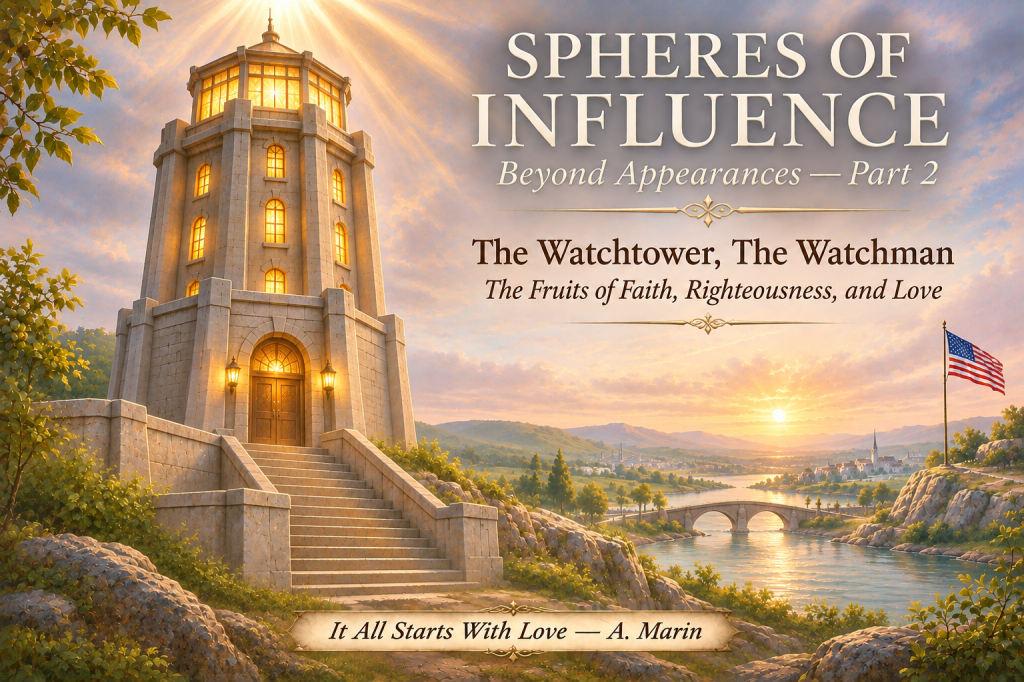
And so, we return to the watchtower.
The Watchtower: A Foundation of Faith
What does it mean to stand upon the watchtower?
Is it merely to observe the world from a higher place, or is it a calling to see beyond appearances, recognize what must be preserved, and understand our responsibilities toward one another?
The watchtower represents vigilance, discernment, preparation, and spiritual responsibility.
Its strength does not rest solely upon the height of its walls, but upon the firmness of its foundation.
Likewise, a nation is not sustained by its institutions alone, but also by the character, wisdom, integrity, and compassion of the people who uphold them.
Institutions establish laws, protect freedoms, preserve order, and provide the structures through which a nation governs itself. Yet it is through the decisions and actions of individuals that these principles are given meaning.
Character teaches us to remain steadfast in our convictions, even when no one is watching.
Wisdom calls us to discern beyond appearances, seek understanding before judgment, and recognize that knowledge carries responsibility.
Integrity requires that our words, decisions, and actions reflect the principles we profess.
Compassion reminds us that righteousness must never become separated from mercy, justice, and love.
“Righteousness exalteth a nation: but sin is a reproach to any people.” — Proverbs 14:34 (KJV)
This passage invites us to examine not only the righteousness we expect from others, but also the righteousness we practice ourselves.
For the strength of a foundation is revealed not merely by what is declared, but by what is faithfully upheld.
The Watchman: Vigilance, Discernment, and Responsibility
“I will stand upon my watch, and set me upon the tower, and will watch to see what he will say unto me.” — Habakkuk 2:1 (KJV)
There is something particularly meaningful about the watchman’s position.
He stands above, not to elevate himself above others, but to see farther. His position carries responsibility, not privilege alone.
He must remain attentive, patient, prepared, and discerning.
The watchman does not stand upon the tower merely to recognize approaching danger. He must understand when action is necessary, when restraint is wise, and how his decisions may affect those entrusted to his care.
Vigilance without wisdom can become fear. Conviction without humility can become pride. Courage without discernment can lead to unnecessary conflict. And authority without compassion can forget the very people it was entrusted to protect.
The watchman’s responsibility is not merely to sound an alarm, but to speak truthfully, exercise sound judgment, and remain grounded in righteousness.
This responsibility extends beyond one individual.
Leaders, educators, parents, public servants, military personnel, guardians, and ordinary citizens each exercise influence within their own spheres of responsibility.
Some are entrusted with protecting communities. Others teach future generations, administer justice, provide counsel, heal, reconcile, or serve the vulnerable.
Each has a place. Each carries responsibility. And each has an opportunity to become a source of light.
Adversity: The Decisions That Reveal a Nation’s Character
A nation’s true strength is reflected not only in its leadership, achievements, prosperity, or military capabilities, but also in how its people treat one another, care for the vulnerable, pursue justice, and respond when confronted with adversity.
It is particularly during times of uncertainty, conflict, and national hardship that the character of a nation and its leaders is tested.
Decisions made to protect a nation require more than authority or strength. They demand wisdom, discernment, courage, integrity, and a profound sense of responsibility toward the lives entrusted to their care.
There are moments when difficult decisions must be made to preserve peace, defend freedoms, protect national security, and safeguard future generations.
Yet those decisions must also be guided by justice, accountability, constitutional principles, respect for human dignity, and an understanding of their consequences.
True leadership requires knowing when to stand firmly, when to seek reconciliation, when to exercise restraint, and when decisive action is necessary to protect others.
Protecting a nation is not merely about recognizing external threats. It is also about safeguarding the moral foundations, constitutional principles, human dignity, and responsibilities that give a nation its strength and purpose.
The responsibility to protect must never become separated from the responsibility to serve.
For what is the purpose of defending a nation if we forget the dignity, freedoms, and well-being of the people who call it home?
“Through wisdom is an house builded; and by understanding it is established.” — Proverbs 24:3 (KJV)
A nation may possess extraordinary resources, but its enduring strength also depends upon the wisdom with which those resources are used and the integrity of those entrusted with exercising authority.
The watchman must therefore remain vigilant not only toward what threatens the nation from beyond its borders, but also toward what must be preserved within them.
Truth. Justice. Liberty. Responsibility. Compassion. And love.
Under Pressure: The Refining of Character
There is a familiar saying, often attributed to Henry Kissinger:
“A diamond is a chunk of coal that did well under pressure.”
Although poetic rather than scientifically literal, the image invites a meaningful reflection.
What if the pressures we encounter are not merely obstacles to overcome, but opportunities to discover the strength, wisdom, and character being cultivated within us?
Adversity can reveal the depth of our convictions, the integrity of our decisions, and the courage required to remain steadfast.
Yet pressure alone does not produce wisdom. Hardship does not automatically make us stronger, nor does endurance alone guarantee righteousness.
It is how we respond to adversity, the decisions we make, and the principles we uphold that determine whether hardship becomes an opportunity for growth or a source of division.
And here we return to the watchman.
The watchman does not abandon his position when the storms approach. He remains attentive, discerning, and prepared, understanding that the greatest responsibility often emerges during the most difficult moments.
A nation’s character, like that of an individual, is revealed not merely in times of prosperity, but in the wisdom, courage, justice, and compassion demonstrated under pressure.
The question is not simply whether we can withstand adversity, but whether we can remain faithful to what is right while passing through it.
“Knowing this, that the trying of your faith worketh patience.” — James 1:3 (KJV)
For faith does not promise the absence of storms. It calls us to remain steadfast through them.
Pressure may test the foundation, but it is character, wisdom, and faithfulness that determine how firmly we stand.
Education: The Seeds We Plant for Future Generations
And here we return once again to Noah Webster and the importance of education.
Education is more than the transmission of knowledge. It is an opportunity to cultivate understanding, encourage discernment, strengthen character, and prepare future generations to exercise their responsibilities with integrity.
Christian education seeks to unite knowledge with spiritual formation, encouraging faith, compassion, service, and moral responsibility.
Yet preserving a religious heritage also calls for respect toward those whose convictions differ. Faith expressed through love does not diminish freedom of conscience; it recognizes the dignity of every person.
For the purpose of education is not merely to teach individuals what to think, but to prepare them to reason wisely, distinguish truth from falsehood, exercise sound judgment, and understand the consequences of their actions.
What we teach today becomes part of what future generations carry tomorrow.
Are we preparing them merely to inherit institutions, or are we also cultivating the wisdom necessary to sustain them?
Are we teaching the importance of defending convictions while also demonstrating the value of listening, understanding, and reconciliation?
Are we planting seeds of division, or cultivating the fruits of righteousness and peace?
The answers are not found in words alone, but in the example we leave behind.
And sometimes, the most revealing lessons are found in the simplest places.
Beyond Red and Blue: Character Begins with the Smallest Things
Recently, while scrolling through social media, I came across a rather funny, yet intriguing meme.
Its message was simple:
It does not matter whether you identify with red or blue if you still do not know where or how to return your shopping cart.
I smiled, but then reflected upon the deeper meaning behind those words.
How interesting that something as ordinary as returning a shopping cart could remind us of a much greater responsibility.
We often speak passionately about leadership, national values, freedom, justice, and the future of our country. Yet how frequently do we overlook the simplest opportunities to practice the very principles we defend?
Returning a shopping cart may seem insignificant. However, it represents a small act of consideration, accountability, and respect for others.
It reminds us that responsibility does not begin when we are entrusted with authority. It begins in the ordinary decisions we make when no one is watching.
Character is not determined by the color we represent, the position we hold, or the convictions we proclaim, but is revealed through the integrity of our actions.
How can we demand accountability from leaders while neglecting opportunities to practice accountability ourselves?
How can we speak of unity while forgetting the simple gestures of kindness that bring people together?
How can we speak of protecting a nation without considering how our everyday actions contribute to the well-being of our communities?
“He that is faithful in that which is least is faithful also in much.” — Luke 16:10 (KJV)
Perhaps some of the greatest lessons in leadership do not always begin in government buildings, classrooms, or places of authority.
Sometimes, they begin in a parking lot, with a shopping cart.
And perhaps that is what makes this reflection so intriguing.
A nation’s character is shaped not only by the decisions made in its highest institutions, but also by the everyday choices of the people who call it home.
For faith, righteousness, and love are not merely principles to proclaim. They are virtues to practice.
In God We Trust — One Nation Under God
“In God We Trust.”
Four words that invite us to reflect upon faith, humility, responsibility, and the source of our strength.
“One Nation Under God.”
Words that remind us of a nation’s aspirations toward unity, liberty, and justice, while inviting each generation to consider the responsibilities accompanying those ideals.
Yet trust in God is more than a declaration engraved upon currency or expressed in a national pledge.
For the believer, it is a daily commitment to seek His wisdom, walk in righteousness, and remain faithful through both prosperity and adversity.
“But seek ye first the kingdom of God, and his righteousness; and all these things shall be added unto you.” — Matthew 6:33 (KJV)
What a meaningful reminder that righteousness is not an afterthought, but a foundation upon which our priorities, decisions, and actions should rest.
To seek first the Kingdom of God is to recognize that faith must be accompanied by obedience, humility, compassion, and service.
It is to remember that achievements and earthly authority do not replace the responsibilities entrusted to us.
The American industrialist, inventor, and philanthropist R. G. LeTourneau is associated with the encouraging words:
“The only difference between can and can’t is a little extra effort.”
These words invite us to consider the importance of perseverance.
Yet perseverance is not merely about working harder; it also requires knowing what is right, exercising wisdom, and remaining faithful to a worthy purpose.
For there are moments when protecting a nation, preserving its foundations, and serving its people require extraordinary effort, difficult decisions, patience, and courage.
And here the watchman returns to his position upon the tower.
He does not abandon his responsibility because the night grows long, nor does he allow adversity to extinguish the light entrusted to his care.
He remains vigilant, not through strength alone, but through preparation, discernment, perseverance, and faith.
Trust in God gives direction to our faith. Righteousness guides our decisions. Perseverance strengthens our service. And love reminds us of the purpose behind it all.
May the words In God We Trust therefore become more than an inscription. May they invite reflection, gratitude, humility, and a renewed commitment to justice, mercy, freedom of conscience, and the dignity of every person.
The Firm Foundation: Building Upon the Rock
In Matthew 7:24–27, Jesus teaches the parable of the wise and foolish builders.
One builds upon rock; the other upon sand.
When the rain descends, the floods come, and the winds blow, the difference between the two foundations is revealed.
The storms do not determine the foundation. They reveal its strength.
How meaningful this becomes when considering the foundations of a nation, the responsibilities of its people, and the spiritual vigilance of the watchman.
Adversity tests our convictions. Difficult decisions reveal our judgment. Responsibility reveals our character. And our actions reveal the fruits of what has been cultivated within us.
Within this devotional reflection:
The rock represents the firm foundation of faith and obedience.
The watchtower symbolizes vigilance, preparation, and responsibility.
The watchman represents discernment, courage, and faithful service.
The light represents truth, wisdom, guidance, and hope.
The fruits become the living testimony of faith, righteousness, and love.
These symbols invite us to reflect upon the teachings of Scripture and the responsibilities entrusted to us.
For the watchtower may stand tall, but its light must reach beyond its walls.
And the watchman must remember that the purpose of the light is not to glorify the tower, but to illuminate the way.
The Fruits of Faith, Righteousness, and Love
“Wherefore by their fruits ye shall know them.” — Matthew 7:20 (KJV)
What fruits are we cultivating in our families, communities, institutions, and nations?
Are we planting seeds of division or reconciliation?
Are we building bridges or barriers?
Are we protecting the dignity of others while preserving our own convictions?
Are we preparing future generations to inherit not merely the structures of a nation, but also the wisdom and moral responsibility necessary to sustain them?
Faith must be accompanied by action.
Righteousness must be expressed through justice and mercy.
Knowledge must be guided by wisdom.
Authority must remain accountable.
And love must extend beyond words into the way we treat one another.
“Blessed are the peacemakers: for they shall be called the children of God.” — Matthew 5:9 (KJV)
Peacemaking is not the absence of courage.
Sometimes it requires extraordinary strength to pursue reconciliation, defend the vulnerable, resist injustice, and remain faithful to what is right.
Nor does compassion require the abandonment of responsibility. Rather, it reminds us why that responsibility matters.
The strongest foundations are not preserved through declarations alone. They are strengthened through faithful actions, humility, courage, forgiveness, and service.
For the true measure of what has been planted within us is revealed through the fruits we bear.
A Closing Reflection: Full Circle
And so, we return to where we began.
To the foundations of a nation.
To the importance of education.
To the responsibilities of the watchman.
To the difficult decisions made in times of adversity.
To the pressure that tests our convictions and reveals our character.
And even to the smallest acts of consideration that remind us what responsibility looks like in everyday life.
Perhaps the greatest battle is not always the one taking place around us, but the one that challenges us to remain faithful to the principles we profess.
To choose understanding over judgment.
To practice righteousness without abandoning mercy.
To preserve wisdom while remaining willing to learn.
To stand courageously without forgetting compassion.
To exercise authority without losing humility.
To defend what is entrusted to our care without forgetting the dignity of those we serve.
For protecting a nation is not simply a matter of strength, strategy, or preparedness. It is also a commitment to preserve the values that give its institutions meaning and its people hope.
A nation is not protected by strength alone, but also by the wisdom of its decisions, the righteousness of its actions, and the love and dignity it preserves for generations to come.
And perhaps this is the greatest lesson of the watchtower.
Its foundation must remain firm.
Its watchman must remain attentive.
Its light must continue to shine.
And its purpose must never be forgotten.
“Let all your things be done with charity.” — 1 Corinthians 16:14 (KJV)
For what we believe must be reflected in how we live.
What we teach must be demonstrated through our example.
And what we seek to preserve for future generations must first be cultivated within our own hearts.
From the highest watchtower to the simplest act of kindness, responsibility begins with us.
The foundation is faith. The calling is service. The responsibility is ours. And the greatest fruit is love.
It All Starts With Love — Todo Comienza Con Amor
Historical, Literary, and Biblical References
Historical and literary references
- Noah Webster (1758–1843). Letter to David McClure, October 25, 1836, concerning Christian religious instruction, education, moral character, and republican government. Reprinted in A Collection of Papers on Political, Literary, and Moral Subjects (1843). This provides the historical basis for the opening discussion of Webster’s educational philosophy.
- The American Patriot’s Bible. Source identified for the opening reflection concerning America’s religious and educational heritage. Exact edition, page, and passage authorship remain to be confirmed.
- Henry Kissinger (1923–2023). “A diamond is a chunk of coal that did well under pressure.” A widely circulated attribution; an authenticated original source has not been established. Used here as a poetic metaphor for adversity and perseverance, not a scientific description of diamond formation.
- R. G. LeTourneau (1888–1969). “The only difference between can and can’t is a little extra effort.” Attributed saying; original primary source not confirmed.
- United States national motto and Pledge of Allegiance. “In God We Trust” was established as the official national motto in 1956. The words “under God” were added to the Pledge of Allegiance in 1954.
- Shopping cart reflection. Adapted from an unattributed social-media meme concerning political colors, personal responsibility, and returning shopping carts.
Biblical references — King James Version
- Proverbs 14:34 — Righteousness and the moral character of a nation.
- Proverbs 24:3 — Wisdom, understanding, and a firm foundation.
- Habakkuk 2:1 — The watchman upon the tower.
- Ezekiel 33:7 — The responsibility of the watchman.
- Matthew 5:9 — Blessed are the peacemakers.
- Matthew 5:14–16 — The light of the world.
- Matthew 6:33 — Seek first the Kingdom of God and His righteousness.
- Matthew 7:16–20 — Recognizing a tree by its fruits.
- Matthew 7:24–27 — The wise and foolish builders.
- Luke 16:10 — Faithfulness in small responsibilities.
- James 1:2–4 — Trials, patience, and spiritual maturity.
- Galatians 5:22–23 — The fruit of the Spirit.
- Ephesians 6:10–18 — Spiritual strength and perseverance.
- 1 Corinthians 16:14 — Let all things be done with love.
Written and Developed by Arlette Sofia Marin
It All Starts With Love — Todo Comienza Con Amor
Writing, Editorial & Research Assistance: ChatGPT (OpenAI)
© 2026 Arlette Sofia Marin. All rights reserved.


Leave a Reply